From the Spot
Frames from Cuiping Hill
Tap to enlarge.
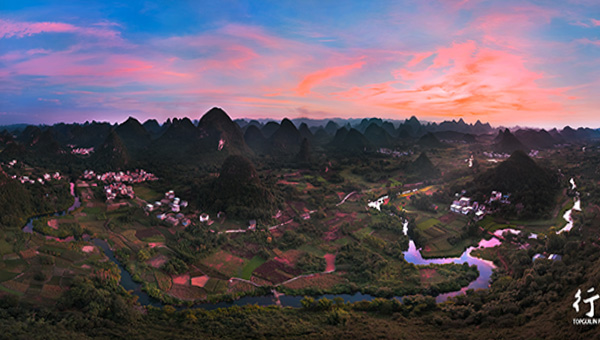
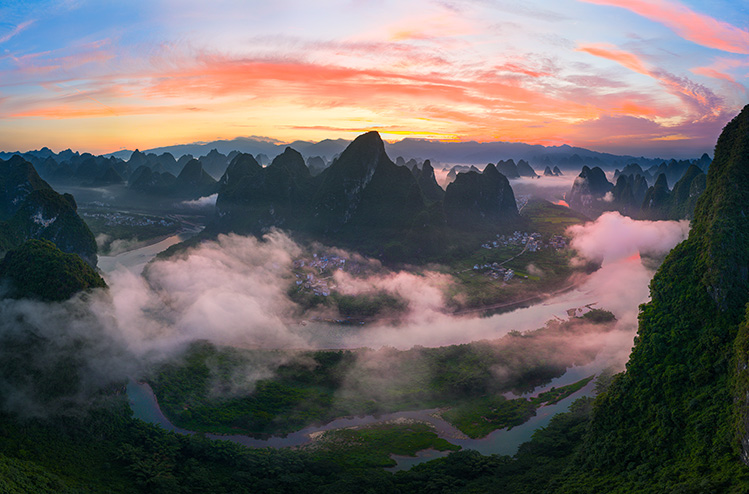

Cuiping Hill delivers the celebrated 'thousand peaks' panorama — row after row of karst fading into the distance. At sunset the layers march from gold through amber to indigo, a minimalist dream.
Summit ridge east — Dawn also works; cool light and thin mist between the layers.
Main summit platform — The marquee moment — layered silhouettes lit gold then sliding into blue.
Ridge line — Indigo layers with the last warm rim on the nearest peaks; long exposure smooths the air.
Cuiping Hill, also called Laocuntou, is the perfect contrast to Xianggong Hill. Instead of looking down into the river, you stand above the karst and gaze out over an endless ocean of green limestone summits, rolling away to the horizon. Few travellers ever see it, because it is only a short walk from the road, but on a clear evening the ridges seem to go on forever — a true "sea of peaks."
Sunset is when the view earns its name. As the sun drops behind the western ranges, each ridge takes on a slightly different colour — the near ones warm and golden, the distant ones fading to violet and blue — so the whole landscape reads with a natural sense of depth. A longer lens brings the rows of hills together into one repeating pattern, while a wider lens keeps the open sky and the soft evening air. The last ten minutes of light are the best of all.
Mar-May. Mist in the valleys lifts the layers.
Jun-Aug. Green and humid; dramatic storm light.
Sep-Nov. Clearest layers and clean colour.
Dec-Feb. Crisp, with possible valley frost.
How a sunset session at Cuiping Hill usually unfolds with our guide.
Climb to the summit platform before golden hour.
First warm light on the near ridges; compose layers.
Peak gold across the sea of peaks.
Slides to amber then indigo; shoot the transition.
Blue-hour layers; long exposure; wrap.
Tap to enlarge.
We time transport, permits and platforms around the light so you're on the spot before it breaks.
Plan My Guilin Trip →